


Tennis
4 min. reading
Published on
01/12/2025
Do you want to enroll your child in tennis but wonder when to start? This question often arises for parents keen on providing the best sporting experience for their little ones. The good news is that there is no single answer: this sport can be adapted for everyone, starting from age 4 and beyond.
In this guide, we explain the ideal period to start, age-appropriate programs, and how to properly equip your young tennis player to ensure they have maximum fun on the court or field.
The ideal age to start tennis according to experts
Most specialists agree that the ideal age to start is between 5 and 7 years old. At this stage of development, children have sufficient coordination, concentration, and understanding of rules to fully benefit from learning. Their motor skills allow them to hold a suitable racquet, track the ball, and follow a coach's instructions.
That said, it is entirely possible to start earlier. From age 4, or even 3 for particularly advanced children, specific programs exist to familiarize toddlers with the world of tennis. At this stage, the goal is not pure technique but motor development, game discovery, and, most importantly, fun. The youngest players learn through playful exercises that stimulate coordination and creativity.
It is also important to keep in mind that every child develops at their own pace. Some may be ready at 4, while others may prefer to wait until 6 or 7. The key is to respect your child’s development and never force them: tennis should remain a moment of joy and discovery, not a constraint.
Tennis by age group: programs for every child
Baby tennis for 3-5 years: gentle introduction
Baby tennis is the perfect gateway for the youngest children. This program is aimed at 3-5 year-olds and takes a completely playful approach. On smaller courts with very light foam balls, children discover the basics without any pressure. Sessions usually last 30 to 45 minutes, perfectly suited to their attention span.
The main goal of baby tennis is not to create champions but to develop hand-eye coordination, balance, and overall motor skills. Exercises often take the form of games: catching projectiles of different colors, aiming at cones, or completing obstacle courses. This pedagogical approach helps children associate tennis with fun, fostering long-term engagement.
Equipment at this stage must be perfectly adapted. Racquets are very short (17 to 21 inches) and ultra-light to avoid tiring small arms. Foam balls bounce slowly, allowing time to react and build strokes gradually.
Mini tennis for 5-7 years: first techniques
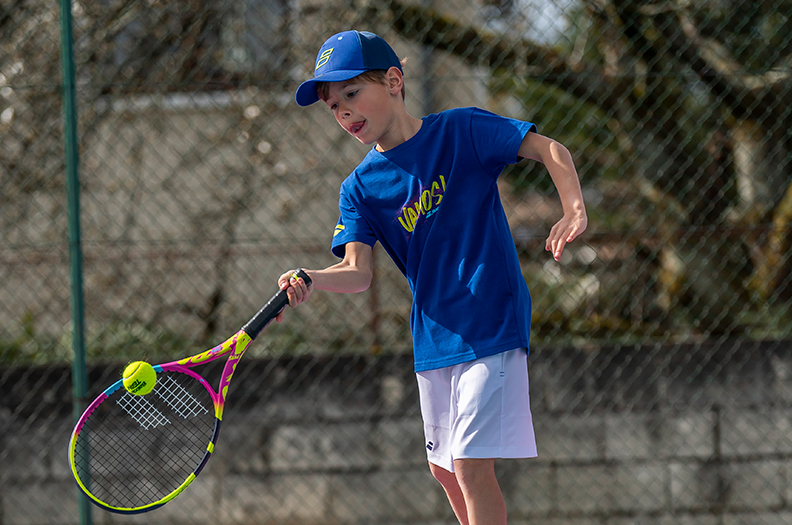
Between ages 5 and 7, young players transition to mini tennis, an intermediate step gradually moving them toward traditional tennis. Courts are still reduced but larger than those used in baby tennis. Equipment evolves: balls are heavier than foam but lighter than standard balls, typically red then orange as they progress.
At this stage, the real learning of fundamentals begins. Children learn to hold the racquet properly, move around the court, and hit forehands and backhands. Basic concepts of serving and rallies are gradually introduced. Sessions generally last one hour, combining practical exercises and match-like situations.
Mini tennis also develops initial tactical understanding: learning where to position themselves, anticipating ball trajectories, and varying shots. Children play their first matches, often in reduced formats, allowing them to experience competition in a supportive environment. Choosing an appropriate racquet is important at this stage to support their development.
Structured tennis from age 7: moving towards regular play
From age 7, children can join more structured lessons and approach the adult-style game. They play on standard-sized courts with green balls (lighter than yellow) or standard yellow balls depending on their level. Lessons become more demanding, introducing all aspects: baseline shots, volleys, smashes, and serving.
This is also the stage where competition becomes accessible for those interested. Youth tournaments allow players to measure themselves against peers and apply what they have learned in training. However, it is important not to rush: competition should complement learning, not become mandatory.
At this stage, regular practice is key. Two sessions per week provide a good balance for improvement without overloading the child. Children develop endurance, refine their strokes, and begin to build their style of play. The coach’s role is central in guiding, correcting, and encouraging progress.
The benefits of tennis for child development
Physical benefits: coordination and endurance
Tennis is a full-body sport that engages the entire body. For young children, it is ideal for developing hand-eye coordination, a fundamental skill for many learning areas. Each stroke requires synchronizing vision, body positioning, and movement—a complex exercise that stimulates the brain and enhances motor abilities.
Constant movement on the court improves agility, reflexes, and balance. Children learn to react quickly, change direction, bend, and jump. This variety of movements promotes well-rounded physical development. Tennis also improves cardiovascular endurance and muscle tone without subjecting the body to violent impacts as in some team sports.
Contrary to common belief, starting young with appropriate equipment poses no growth risks. On the contrary, it strengthens bones and joints progressively, provided recovery times are respected and overtraining avoided.
Psychological and social benefits
Beyond the physical, tennis develops mental skills. It is an individual sport requiring concentration, perseverance, and emotional management. Children learn to handle wins and losses, bounce back from mistakes, and stay calm under pressure—valuable skills transferable to other areas of life.
It also teaches respect: for opponents, referees (or self-refereeing), and rules. Fair-play and discipline are central to practice. Young players develop autonomy by making tactical decisions and managing their equipment.
Socially, while tennis is individual, it provides opportunities to meet others. Group lessons, camps, and tournaments foster friendships. Parents appreciate the community atmosphere around clubs.
Choosing the right equipment to start tennis
Racquets suited to age and height
Choosing appropriate equipment is essential to allow your child to progress under optimal conditions. Oversized or heavy gear can quickly tire or discourage children and may even cause arm or shoulder discomfort. Conversely, properly sized gear facilitates learning and increases enjoyment.
Racquet size should be based on the child’s height, not age. A simple test: standing with the racquet alongside the body, arm extended downward; if the racquet head is about 5 cm from the ground, it is the right size. General guide:
● less than 1m: 17–19 inches (baby tennis)
● 1m–1.15m: 21–23 inches (early mini tennis)
● 1.15m–1.35m: 23–25 inches (advanced mini tennis)
● 1.35m–1.50m: 25–26 inches (transition to adult play)
● over 1.50m: 26–27 inches (adult size)
For beginners, aluminum racquets are recommended: lightweight, durable, and affordable. Junior babolat racquets offer models for each level, from baby to competitive play.
Balls and essential accessories for young players
Balls play a key role in learning. Modern tennis uses a progressive ball system adapted to development:
● foam balls: for babies, ultra-light and safe
● red balls: 75% slower than standard, ideal for ages 5–7
● orange balls: 50% slower, for ages 7–9
● green balls: 25% slower, transition to adult play
● yellow balls: standard for advanced players
These versions allow children to build rallies and gain confidence gradually. Other useful accessories include cushioned shoes (avoid running shoes), comfortable clothing, a bag to carry equipment, and optionally a sweat-grip for better handling.
Where and how to enroll your child in tennis
Finding the right club or tennis school
Choosing a club is crucial to your child’s experience. Consider:
· proximity: a nearby club encourages attendance
· facilities: are they suitable and safe for young children?
· coaching: are instructors certified and experienced with young players? Observe a session to assess atmosphere and teaching style. A good coach balances rigor with fun.
Clubs certified by the french tennis federation (fft) generally guarantee quality teaching and infrastructure.
Many clubs offer free trial sessions—ideal for children to experience tennis before committing. Consider the club's focus: competition or leisure and socializing. Choose according to your child’s personality and family expectations.
Different lesson formats for children
Group lessons are common: 4–8 participants of similar levels for one hour. They promote motivation, socialization, and cost-effectiveness—perfect for beginners.
Individual lessons offer personalized instruction for faster progress or competitive goals, costing 30–50 euros per hour. Mixed formats are also popular: one group lesson weekly plus one individual lesson monthly.
Holiday camps are excellent for discovery or intensive practice: usually 2 hours daily for a week, providing immersive experience and motivation boosts.
For regular practice, 1–2 sessions per week is optimal: enough to progress without impacting other activities or rest.
Practical tips for supporting your beginner child
Parents play a key role. Prioritize fun over performance. Avoid pressure that may turn tennis into a chore. Encourage efforts, not just results. Show interest without being overly demanding.
Be patient with progress: tennis requires time. Frustration and plateaus are normal. Support and encouragement help children persevere.
Do not become a sideline coach; let instructors do their job. Too many conflicting tips can confuse children. After sessions, simply ask if they had fun and what they enjoyed.
Regularity is important, but avoid overloading: children need free time, family moments, and diverse activities. Balance engagement with freedom.
If possible, set an example: play occasionally with your child. Some clubs offer parent-child sessions—a great opportunity for bonding.
Teenagers or adult beginners? It’s never too late
While this guide mainly targets young players, it’s important to note that anyone can start at any age. Teens or adults can enjoy tennis and progress significantly. Tennis is often called a “sport for life” because it can be practiced from childhood to old age.
Learning differs from that of a young child: adults have better tactical understanding but must focus more on coordination and smooth strokes. With good instruction and consistency, progress comes at any age.
Many clubs offer beginner classes for adults in a friendly, non-judgmental atmosphere. The physical, mental, and social benefits are the same: cardiovascular health, muscle strengthening, coordination, stress management, and socialization. Playing with children also strengthens family bonds.
If you’ve never played, take a racquet and join in—tennis welcomes all ages.
Conclusion
To answer the initial question: the ideal starting age is 5–7, but every child is different. Baby tennis from 3–4 offers a gentle introduction, while teens and adults can also start and progress. The key is to respect each child’s pace, choose appropriate equipment, and prioritize fun over performance.
Tennis provides a fantastic environment for physical, mental, and social development. With proper support, suitable equipment, and a nurturing environment, your child can have a wonderful tennis journey. So don’t wait: visit a club and let the magic happen!
You may also like

Mastering padel hitting techniques: complete guide to improve
4 min. reading
Published on
29/10/2025